


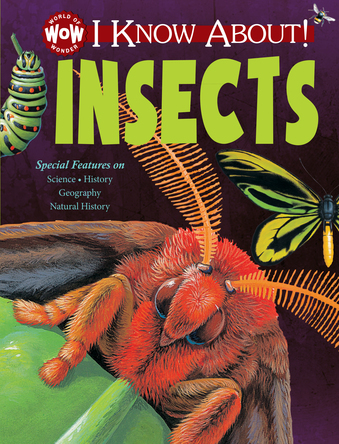









Extrait du livre I Know About! Insects
I Know About! Children will be WOWed when they dive into this fun, fact-packed series that explores the most fascinating things in the world around them. From the human body, to sharks, to insects, to atlases, to dinosaurs, there is something new and exciting to learn These books are anchored by the philosophy that the best form of learning is through high-quality, multi-faceted experiences. This series provides lasting knowledge as it engages children on many levels. The graphics and illustrations inspire learning in readers of all ages as they explore everything from the depths of the ocean to the cells of the human body. Students will also be captivated by the fun facts and interesting explanations, which bolster a comprehensive understanding of each subject area. Teachers and parents alike will appreciate the significance of this series as an addition to their libraries as it promotes self-sufficiency in the learning process. With vividly portrayed information on all of children's favorite subjects, these books promote an enjoyment for both discovering and sharing knowledge, key components of a successful learning environment. Learning should be fun, interesting, and applicable, and we are sure the young learners in your life will find this series to be all of that ≠ and more! "You can teach a student a lesson for a day; but if you can teach him to learn by creating curiosity, he will continue the learning process as long as he lives." Clay P . Bedford
Contents 6 What are insects? 8 Life cycles 10 Getting about 12 Senses 14 Poison and Stings 16 Bugs 18 Beetles 20 Flies 22 Butterflies and moths 24 Bees and wasps 26 Ants and termites 28 Classification of insects 29 Glossary 30 Index
WHAT ARE INSECTS ? Insects are the most successful of all animal groups, making up 85 percent of the whole animal kingdom. There are as many as 10,000 insects living on every square yard of the Earth's surface. There Antennae are many different kinds of insects, but all share a common body (see pages 12-13) design, adapted to cope with every possible environment, and to eat every possible kind of food. All adult insects have a segmented body which is divided into three parts: head, thorax, and abdomen. An insect's skin is made of a tough substance called "chitin." This forms a hard shell, or exoskeleton, which protects the insect's organs. The leg and wing muscles are securely anchored to the exoskeleton. It is waterproof, and prevents the insect from drying out. But it does not allow air through. Holes in the skin, called "spiracles," lead to breathing tubes. The exoskeleton does not grow. As an insect gets bigger, it must shed its old skin, and grow a new one. The outer skin, or cuticle, is patterned and colored for camouflage or warning (see pages 14-15). Emperor dragonfly Common cockroach Bush cricket Seven-spotted ladybird (beetle) Privet hawkmoth Firebug Bluebottle (fly) Wood ant Biblical insects The Bible contains many stories about Samson, a hero who possessed great strength. One story tells how he killed a young lion which threatened him. Later, he noticed bees flying from the lion's body and found honey inside it. He made his discovery into a riddle: "Out of the eater came forth meat, and out of the strong came forth sweetness." No one could guess the answer. In fact, the insects were probably not bees at all, but carrion flies that live on rotting flesh. The explanation of the honey is still a mystery! Samson discovers the bees. The head contains a simple brain which receives messages from the sense organs and controls the muscles. The thorax is made of three segments fused together. It carries the legs and wings. The abdomen contains the organs for digestion and reproduction. Preserved in stone Insects first appeared on Earth about 370 million years ago. Early species had no wings; they fed on the sap and spores of the newly-evolved land plants. Insects were the first creatures to conquer the air, 150 million years before birds first flew. This is a fossil of an early dragonfly that lived 300 million years ago, in the steamy Carboniferous forests with the ancestors of the dinosaurs. All insects have three pairs of jointed legs, and most have four wings. Insects from some easily recognizable insect groups are shown above. The classification of insects is explained on page 28. Insect relatives Insects belong to a group of animals called "arthropods." They all have segmented bodies with hard exoskeletons. But the other arthropods pictured here are not insects. Spiders have eight legs. Their body segments are fused in two parts--a head-thorax and an abdomen. Millipedes and centipedes have many body segments, with legs on each.
LIFE CYCLES Insects hatch from eggs. Young insects are eating machines. They consume as much food as they can in order to grow to adulthood as quickly as possible, and shed or molt their skins as they expand. Their goal as adult insects is to mate and lay eggs, and so the life cycle begins again. The change from young to adult form is called "metamorphosis." In many species the young insects turn into adults gradually. In some species, however, the change is quite dramatic. These young insects, or larvae, often have a different diet to their parents. They live their early life in a form very different to their adult shape. Caterpillar watch (3 months) Summer is the time to observe the life cycle of butterflies, such as the large white butterfly. You may be lucky enough to find some eggs or caterpillars, and wish to remove them for study and identification. Place them, with the leaves on which you found them, in a box covered with muslin. Keep the box in a cool, moist place and replace the leaves with the same kind every day. Watch the caterpillars grow, and count how many times they molt before they pupate. When the butterflies emerge, watch them unfurl their wings by pumping blood into the veins. Let the butterflies go. Complete metamorphosis Some kinds of insects undergo a much more dramatic change as they grow from larvae to adults. As grubs or caterpillars, the young of these species look nothing like adult insects. They eat constantly and molt whenever their skin gets too small. Eventually, the larvae anchor themselves to a safe spot by a silken thread, and molt to reveal a chrysalis. The chrysalis looks motionless, but inside a great transformation is going on. Long, jointed legs and antennae form, and wings develop. At last the chrysalis bursts open and a completely different animal emerges. This dramatic change is called "complete metamorphosis." Incomplete metamorphosis In many species the transformation from young to adult form is gradual. Young locusts are called "nymphs." Newly hatched nymphs look a little like small, wingless adults. As they grow, they shed their skin whenever it gets too small. Each time they molt they become more like adults. They emerge from their final molt complete with wings and reproductive organs, ready to fly off, find a mate and lay eggs. This gradual change is incomplete metamorphosis. Cockroaches, bugs, and dragonflies also have incomplete metamorphosis. Caring parents Many insect parents go to a lot of trouble to protect their newly hatched young and provide a ready supply of food. Butterflies lay their eggs on a suitable food plant. Gall wasps choose plants that will grow a protective gall around the larvae. Some wasps paralyze an insect victim and drag it into their burrow for the larvae to feed on. Female cockroaches carry their eggs around with them until they are almost ready to hatch. Earwig mothers carefully clean their eggs and young. Some species of ichneumon wasps lay their eggs in a living caterpillar. Once hatched, the grubs feed on the caterpillar's insides. The grown larvae burst through the caterpillar's skin, and turn into pupae. Life charts The red admiral spends one week as an egg, five weeks as a caterpillar, two weeks as a pupa, and nine months (39 weeks) as an adult. The pie chart below represents this life cycle. Make a similar chart for the stag beetle, which spends two weeks as an egg, three years (156 weeks) as a caterpillar, eight months (35 weeks) as a pupa, and four weeks as an adult. Add the total number of weeks. Work out what percentage each stage is by multiplying each by 100 and dividing by the total of weeks. Then, multiply each figure by 3.6 to find out how many degrees it represents of a circle. Mark out the degrees with a protractor.
GETTING ABOUT Insects are masters of land, air, and fresh water. They use their legs and wings to move about efficiently in each environment. Most kinds of insects have two sets of wings for flying, gliding, and hovering. These fragile structures are strengthened by veins. In beetles the front pair of wings has adapted to form hard wing cases. In flies the two hind wings have become balancing organs called halteres. An insect's six legs have strong muscles for walking, running, jumping, and swimming. Some flies can cling upside down because of the hairs and pads on the ends of their legs (see pages 20-21). Fleas jump using a "click box" mechanism similar to flying insects. They actually jump by relaxing their muscles, to allow the thorax to "click" outward. Fleas can jump up to 12 inches, 130 times their own height! Performing fleas Fleas are amazingly strong and have a good sense of balance. In Victorian times, these tiny animals were harnessed with fine wire, and made to walk tightropes in "flea circuses." The fleas were not "trained" to perform tricks, but were trying their best to escape. Vertical muscles contract, wings flap up. Horizontal muscles contract, wings flap down. Flapping the wings Horizontal and vertical muscles are attached internally to the hard skeleton of the insect's thorax, which acts like a "click box." The sets of muscles contract alternately to make the insect's wings beat powerfully and rapidly. When the vertical muscles contract to pull down the roof of the thorax, it springs inward and the wings are flipped upward. When the horizontal muscles contract, the ends of the thorax are pulled in; the roof "clicks" back to its domed shape and the wings are flapped downward. Flight music "The Flight of the Bumble Bee" is a piece of music by RimskyKorsakov. This Russian composer based his operas on fairy tales and folk-legends, and used the orchestra to make the sounds in the stories. The piece has a fast time, or tempo, which imitates the rapid buzzing of a bee's wings as it flies up and down looking for flowers. Caterpillar tread Many caterpillars have three pairs of proper legs at the front of their bodies, and five pairs of false legs, with suckers on the end, at the rear. The caterpillar moves one pair of legs at a time, distributing its weight equally over the other legs. This allows it to move over obstacles in its way. "Caterpillar tracks" based on the same principle are used on heavy vehicles like bulldozers, tractors, and army tanks. They distribute the vehicle's weight evenly, so it can travel over rough or slippery ground. Swimming insects Many species of insects live in water (see pages 16-17). Their legs are adapted for swimming. The great diving beetle (left) lives in water both as larva and adult. The adult beetle is a ferocious predator. It swims by rowing through the water with its wide, flat, back legs. It also flies well. Migrations Many insects fly great distances to avoid winter cold. Monarch butterflies hold the long-distance record for such journeys, or migrations, as shown below. In September, these butterflies fly south from Canada, across North America, to Mexico. They travel up to 1,200 miles, 80 miles per day. On reaching their destination, they hang in great clusters on pine trees and begin their hibernation, or winter sleep. In the spring they drift back to lay their eggs on the Canadian milkweed plant. Routes of monarch butterfly Limit of northern range


