





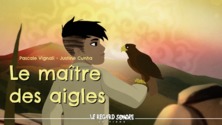


Extrait du livre The master of eagles
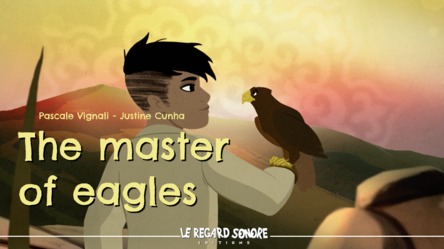
The master of eagles Pascale Vignali Illustrated by Justine Cunha Le Regard Sonore Editions
Once there was ... The Altai in Mongolia. Mongolians call it the golden mountain. When the sun sets on its eternal snows, the Altai seems to illuminate the vast steppe with a light all of its own... It is the realm of the berkut, a magnificent golden eagle that Mongols consider a sacred animal. A special bond unites these earthbound nomad horsemen to the king of the skies. As in this beautiful story of friendship that took place in the heart of the infinite landscapes of Mongolia ...
Sashka was a young boy who lived in the desert at the foot of the Altai. Like all Mongols, he lived in a yurt with his family. Round and white, yurts were covered with several layers of camel hair cloth. And so, they withstood the harshest winters and stayed cool in the summer. Inside, carpets and embroidered hangings made this nomadic home a warm haven in a harsh environment.
When grass became too scarce to feed the herds of yaks, goats and sheep, families dismantled their yurt - and the whole camp moved on horseback to the next plain. Yurts and furniture would follow, on the backs of camels …
Sachka loved this season as it meant he and his father would soon go hunting together. They would ride their horses on the mountain paths and return to the camp with a hare or a fox.
One day, Sachka sensed movement between two rocks. He dismounted and approached : SACHKA : Wait Daddy, there is an animal hidden in there… It looks … Ohhh, it’s a baby berkut! Black feathers and grey down, the eaglet furiously beat with one wing while the other hung down miserably. Sashka's father shook his head: FATHER : Yes, a berkut. But it has a broken wing. It has no chance of surviving on its own. It is the law of nature ... Yet the eaglet was staring at the boy with such fierce courage that Sachka could not abandon it. SACHKA : I’ll take him !
FATHER : Sachka ! It will never fly, it's an extra mouth to feed and it will be worthless! It's a wild animal! But the boy was determined: SACHKA : I'll take care of him dad, me alone. I will look after him and you'll see, one day he will fly!
Sachka fashioned a wooden splint, and settled the bird in the family yurt. He fed it little pieces of raw meat. He made a hard leather glove so the bird could perch on his arm... and then he fixed a support on the front of his saddle so that he could rest his arm with the recuperating eaglet on it. Wherever he went, the bird went with him. Like a living statue, it pierced the world with its imperial gaze. But he would not fly. Whenever Sachka removed the splint, the wing would drop. and the bird just look away. The young Mongol refused to give up; every day he unfolded the wing, week after week, season after season ...


